Introduction
Accurate cost estimation starts with a well-prepared Bill of Materials (BOM).
However, in real-world projects, material prices fluctuate due to market volatility, supplier variation, and logistics costs.
Therefore, estimators use price range estimation methods instead of fixed prices.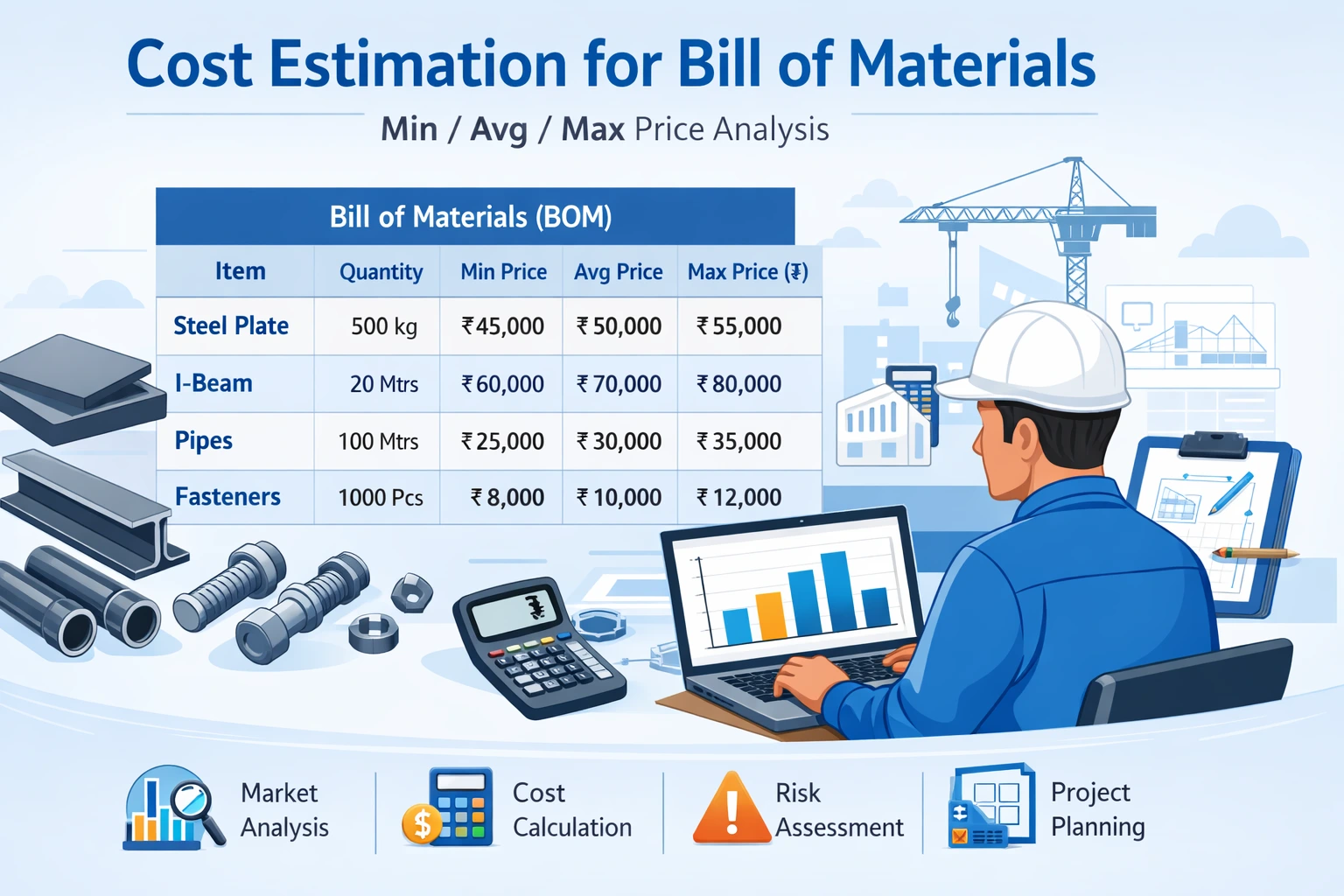
This article explains the most reliable BOM price range estimation methods, their formulas, and practical fabrication examples to help estimators, project managers and cost engineers make informed decisions.
What Is BOM Price Range Estimation?
BOM price range estimation is a technique where material costs are calculated using minimum, average, and maximum price limits instead of a single value.
Why Price Range Estimation Is Important
Price range estimation is important because material costs are not fixed and often change due to market fluctuations, supplier differences, transportation and taxes.
Using a price range instead of a single rate helps estimators in many ways like:
- Manage uncertainty
- Handles steel price fluctuations
- Reduce the risk of cost overruns and
- Prepare more realistic project budgets.
- Helps management approve budgets with confidence
It also supports better decision-making during tendering and improves cost control throughout the project lifecycle.
BOM Estimation Techniques
Accurate Bill of Materials (BOM) estimation requires selecting the right technique based on project stage, data availability and risk level.
Using the right BOM estimation technique improves cost accuracy, reduces financial risk, and supports confident project decision-making.
Try Our Free Online Cost Estimation Calculator
Instantly calculate material, labor, overhead, GST, and profit for your project with RK Estimation tools.
In practice, a combination of methods delivers the most reliable BOM cost estimate.
Below are the most widely used BOM estimation techniques, explained in detail with practical context.
1. Historical Data–Based Estimation
This technique uses material cost data from previous similar projects as a reference.
How it works
- This method uses past project material prices as reference.
- Analyze past BOMs for similar size, scope, and material type
- Adjust prices for inflation, location, and market trends
Formula
Estimated Price Range = Historical Price ± Price Variation (%)
Example (Fabrication): Historical MS Plate Price: ₹65/kg & Expected variation: ±10%
Estimated Range: ₹58.50/kg to ₹71.50/kg
Advantages |
Limitations |
Best used when |
| Quick and easy to apply | Less accurate if market conditions change significantly | Project scope is similar to completed projects or Similar projects executed recently |
| Reliable for repeat or standardized projects | Limited time is available for estimation. Stable suppliers available |
2. Supplier Quotation Range Method
Material prices are estimated using multiple vendor quotations.
How it works
- Multiple vendor quotations are collected to define the price range.
- Collect minimum 3 quotations for each BOM item
- Define Min, Avg, and Max price range
Formula
Price Range = Lowest Quote to Highest Quote
Example:
| Supplier | Price (₹/kg) |
|---|---|
| Vendor A | 68 |
| Vendor B | 72 |
| Vendor C | 75 |
BOM Price Range: ₹68 – ₹75/kg
Advantages |
Limitations |
Best used when |
| High accuracy and High reliability for tendering | Time-consuming | Tendering and final budgeting stage |
| Reflects current market conditions. High reliability for tendering | Quotes may change before order placement |
3. Parametric Estimation Technique
This method estimates material cost using unit-based parameters such as weight, length, or area.
How it works
Cost is estimated using price per unit weight, length or area.
Formula
Material Cost = Quantity × Rate Range (₹/kg, ₹/m, ₹/m²)
Example:
Structural Steel Weight: 12,000 kg & Rate Range: ₹64 – ₹70/kg
Cost Range: ₹7.68 lakh – ₹8.40 lakh
Advantages |
Limitations |
Best used when |
| Fast estimation for large BOMs | Less detailed | Conceptual or feasibility stage |
| Suitable for early-stage planning and Early project budgeting | Requires reliable unit rates | Concept-level estimation |
4. Three-Point (PERT) Estimation Technique
Uses three price scenarios to calculate a statistically weighted expected cost.
How it works
A statistically reliable method using optimistic, most likely and pessimistic prices.
Inputs
Optimistic (Minimum price)
Most likely (Average price)
Pessimistic (Maximum price)
Formula
Expected Cost = (Min + 4×Avg + Max) / 6
Example:
Optimistic Price: ₹62/kg, Most Likely: ₹66/kg, Pessimistic: ₹72/kg
Expected Price: ₹66.7/kg
Advantages |
Limitations |
Best used when |
| Accounts for uncertainty and risk | Requires experience to define price ranges | High-risk projects |
| More realistic than single point estimates | Long duration projects |
5. Index-Based Price Escalation Technique
Used when material prices are expected to change over time.
How it works
Base material price is adjusted using official price indices
Formula
Revised Price = Base Price × (Current Index / Base Index)
Example:
Base Steel Price: ₹60/kg
Base Index: 210
Current Index: 235
Revised Price: ₹67.14/kg
Advantages |
Limitations |
Best used when |
| Ideal for long-term contracts | Depends on availability of reliable indices | Infrastructure and EPC projects |
| Reduces escalation disputes | Long-term contracts |
6. Contingency-Based Estimation
Adds a risk buffer to the estimated BOM cost.
How it works
Adds risk buffer to BOM pricing.
Apply contingency percentage based on risk assessment
Formula
Final Price Range = Base Estimate ± Contingency (%)
Typical Range
Low risk: 3–5%
Medium risk: 5–10%
High risk: 10–15%
Example:
Base Estimate: ₹80 lakh
Contingency: ±8%
Final Range: ₹73.6 – ₹86.4 lakh
Advantages |
Limitations |
Best used when |
| Protects against unforeseen price changes | Overestimation if contingency is excessive | Final budget approval stage |
7. Hybrid BOM Estimation Approach (Best Practice)
Combines multiple techniques for higher accuracy.
Example
Historical data for base rate
Supplier quotes for validation
Three-point estimation for risk handling
Benefits
Balanced accuracy and risk control
Preferred for professional estimation
Comparison Table of BOM Price Range Estimation Methods
| Method | Accuracy | Risk Handling | Best Stage |
|---|---|---|---|
| Historical | Medium | Low | Budgeting |
| Supplier Quotes | High | Medium | Tender |
| Parametric | Medium | Medium | Concept |
| Three-Point | High | High | Planning |
| Index-Based | High | High | Long-term |
| Contingency | Medium | High | Final Estimate |
Best Practices for Accurate BOM Price Range Estimation
Update steel & material rates monthly
Maintain a price history database
Use multiple estimation methods together
Always include taxes, freight & wastage
Automate BOM estimation using calculators
FAQs
It is a method of estimating material costs using minimum, average and maximum price limits.
Supplier quotation and three-point estimation methods provide the highest accuracy.
Fixed prices fail to account for market fluctuations and increase project risk.
Conclusion
Using BOM price range estimation methods help project teams manage uncertainty, improve budgeting accuracy, and reduce financial risk. Combining historical data, supplier inputs, and statistical techniques ensures reliable cost forecasting in fabrication and construction projects.