Introduction
Gas Metal Arc Welding (GMAW), commonly known as MIG Welding, is one of the most widely used welding processes in fabrication, construction, automotive, manufacturing and heavy engineering industries.
While MIG welding is known for high productivity, quality welds and ease of automation make it a preferred choice for both small workshops and large-scale industries, accurate costing of GMAW welding is critical for preparing competitive bids, controlling fabrication expenses and improving project profitability.
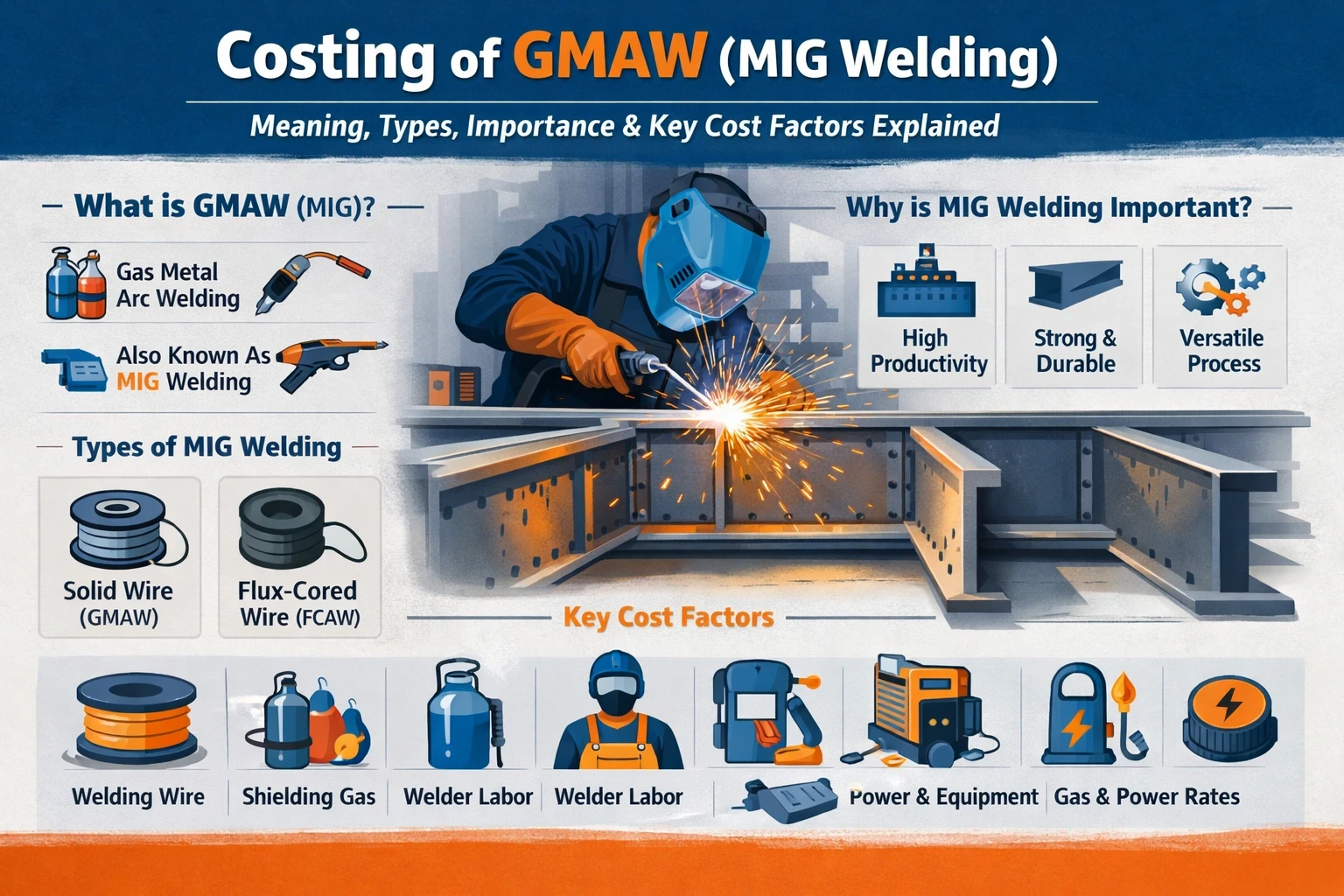
This blog explains MIG welding costing in a practical, step-by-step manner, including meaning, types, importance, cost components, formulas and worked examples.
What is GMAW (MIG Welding)?
Gas Metal Arc Welding (GMAW) is a semi-automatic or automatic welding process in which a continuous solid wire electrode is fed through a welding gun, protected by a shielding gas (CO₂, Argon, or mixed gases).
Refer below table for main feature and Description of GMAW (MIG Welding)
| Feature | Description |
|---|---|
| Electrode | Continuous solid wire |
| Shielding Gas | CO₂ / Argon / Mixed gas |
| Power Source | Constant voltage |
| Productivity | High |
| Skill Requirement | Medium |
| Applications | Structural steel, pressure vessels, pipelines, automotive |
Types of GMAW/MIG Processes and Their Cost Impact
GMAW can be performed in different modes of metal transfer. Each mode affects welding cost due to differences in wire feed speed, heat input, penetration, and productivity.
1. Short-Circuit Transfer
Short-Circuit Transfer (in MIG/GMAW) is a welding mode where the molten wire electrode repeatedly touches the weld pool, creating a short circuit. The current drops, the metal transfers, and the arc reignites—this cycle happens many times per second.
In short:
- Low heat input→ less distortion
- Suitable for thin materials
- Works well in all welding positions
- Uses CO₂ or Argon–CO₂ mix
- Lower equipment and shielding gas cost
- Slower deposition rate → higher labor hours
- Common in fabrication and repair work
👉 Cost impact: Lower power and gas consumption, but lower deposition rate compared to spray transfer.
2. Globular Transfer
Globular Transfer (in MIG/GMAW) is a welding mode where large droplets of molten metal form at the wire tip and transfer to the weld pool under the force of gravity.
In short:
- Medium to high heat input
- Produces larger, irregular droplets
- Causes more spatter→ increased cleaning cost
- Typically uses CO₂-rich shielding gas
- Suitable mainly for flat and horizontal positions
- Less efficient, not preferred for precision work
👉 Cost impact: Higher spatter and cleanup increase overall welding cost compared to short-circuit transfer.
3. Spray Transfer
Spray Transfer (in MIG/GMAW) is a welding mode where fine droplets of molten metal are sprayed continuously across the arc into the weld pool without short-circuiting.
In short:
- High heat input → Increased power cost but reduced man-hours
- Requires higher voltage and gas purity
- Very stable arc with minimal spatter
- High deposition rate → faster work
- Uses Argon-rich shielding gas
- Best for thick materials, long welds and flat/horizontal positions
👉 Cost impact: Higher power and gas cost, but lower labor time per meter due to high productivity.
4. Pulsed Spray Transfer
Pulsed Spray Transfer (in MIG/GMAW) is an advanced welding mode where the welding current pulses between a high peak and low background level, allowing controlled spray transfer at lower average heat input.
In short:
- Controlled heat input → Lower heat input than spray transfer
- Stable arc with minimal spatter → Excellent quality with less spatter
- Suitable for thin to medium thickness materials
- Works in all welding positions
- Best for stainless steel and aluminum fabrication
- Requires advanced pulsed MIG power source
- Higher machine cost due to advanced equipment
👉 Cost impact: Higher machine cost, but reduced distortion, rework, and overall fabrication cost.
Cost Impact of Different Types of GMAW/MIG Processes
Each mode impacts the overall welding cost through consumable usage, productivity levels and rework requirements.
Refer below table for Cost Impact of Different Types of GMAW/MIG Processes of GMAW (MIG Welding)
| Type of GMAW | Description | Cost Impact |
|---|---|---|
| Short Circuit Transfer | Low heat input, thin plates | Lower power & wire cost |
| Globular Transfer | Medium thickness | Moderate spatter cost |
| Spray Transfer | Thick plates, high deposition | Higher power & gas cost |
| Pulsed MIG | Controlled heat input | Higher equipment cost but less rework |
What is GMAW/MIG Welding Costing?
GMAW/MIG welding costing refers to calculating the total expenses involved in performing a MIG welding operation.
This includes direct costs like filler wire and shielding gas, and indirect costs such as equipment depreciation, power usage, welder efficiency, joint preparation, and inspection requirements.
Understanding the cost of GMAW is essential for accurate project estimation, budgeting and optimizing fabrication efficiency.
Why MIG Welding Costing is Important?
GMAW/MIG Welding Costing helps to determine the true investment required for each weld bead or joint so fabrication companies can prepare accurate project bids and improve cost control. Accurate MIG welding costing helps to:
Prepare realistic fabrication estimates
Avoid underquoting or losses
Compare manual vs automated welding
Optimize wire, gas and power consumption
Improve project cost control
Key Cost Components in GMAW/MIG Welding
A complete GMAW cost estimation typically includes Direct welding cost and Indirect welding cost as below:
Direct Welding Costs
Refer below table for Major Direct Welding Costs of GMAW (MIG Welding)
Sl. No. | Cost Element | Description | Key Cost Parameter |
|---|---|---|---|
01 | Labor Cost (Welder) | Skilled operator cost |
|
02 | Welding Wire (Filler Wire Cost) | Wire type (ER70S-6, SS, aluminum etc.) |
|
03 | Shielding Gas Cost | Gas composition (CO₂/ Argon/ Mix), Ar-CO₂ mix, Ar-He mix) |
|
04 | Machine Cost and Consumables | Equipment Depreciation & Maintenance |
|
05 | Power Consumption | Welding machine electricity |
|
Indirect Costs
Refer below table for Major Indirect Welding Costs of GMAW (MIG Welding)
Sl. No. | Cost Element | Description | Key Cost Parameter |
|---|---|---|---|
06 | Setup Time and Idle Time | Joint Preparation, alignment, Waiting, Repositioning |
|
07 | Inspection & Quality Costs | Visual/ NDT |
|
Key Factors Affecting MIG Welding Cost
Refer below table for Key Factors affecting MIG Welding Cost and its Impact
| Factor | Impact on Cost |
|---|---|
| Plate Thickness | Higher thickness → more weld metal |
| Welding Position | Overhead increases time |
| Joint Type | Groove weld costs more than fillet |
| Deposition Rate | Higher rate reduces labor cost |
| Gas Selection | Argon mix is costlier than CO₂ |
| Automation | High initial cost, low running cost |
MIG Welding Cost Reduction Tips
Use CO₂ instead of Argon mix where acceptable
Improve joint fit-up
Increase deposition rate
Reduce rework & spatter
Consider automation for repetitive jobs
FAQs – MIG Welding Costing
Yes, MIG has higher productivity and lower labor cost per meter.
CO₂ is the most economical shielding gas.
Labor time and deposition rate have the highest impact.
Conclusion
MIG welding costing is not just about wire and labor—it is a combination of material, time, machine, gas, and efficiency factors. A systematic approach to GMAW cost estimation ensures accurate pricing, better profitability, and improved fabrication planning.