Transportation cost plays a critical role in construction, manufacturing, logistics and supply chain management.
Whether you are estimating project costs, preparing a bill of quantities (BOQ) or managing procurement, understanding transportation costs is essential for accurate budgeting and profitability.
In this guide, we’ll clearly explain the meaning of
transportation cost, its types, importance, and the key
factors that affect transportation cost, with practical insights for
engineers, estimators, project managers and business owners.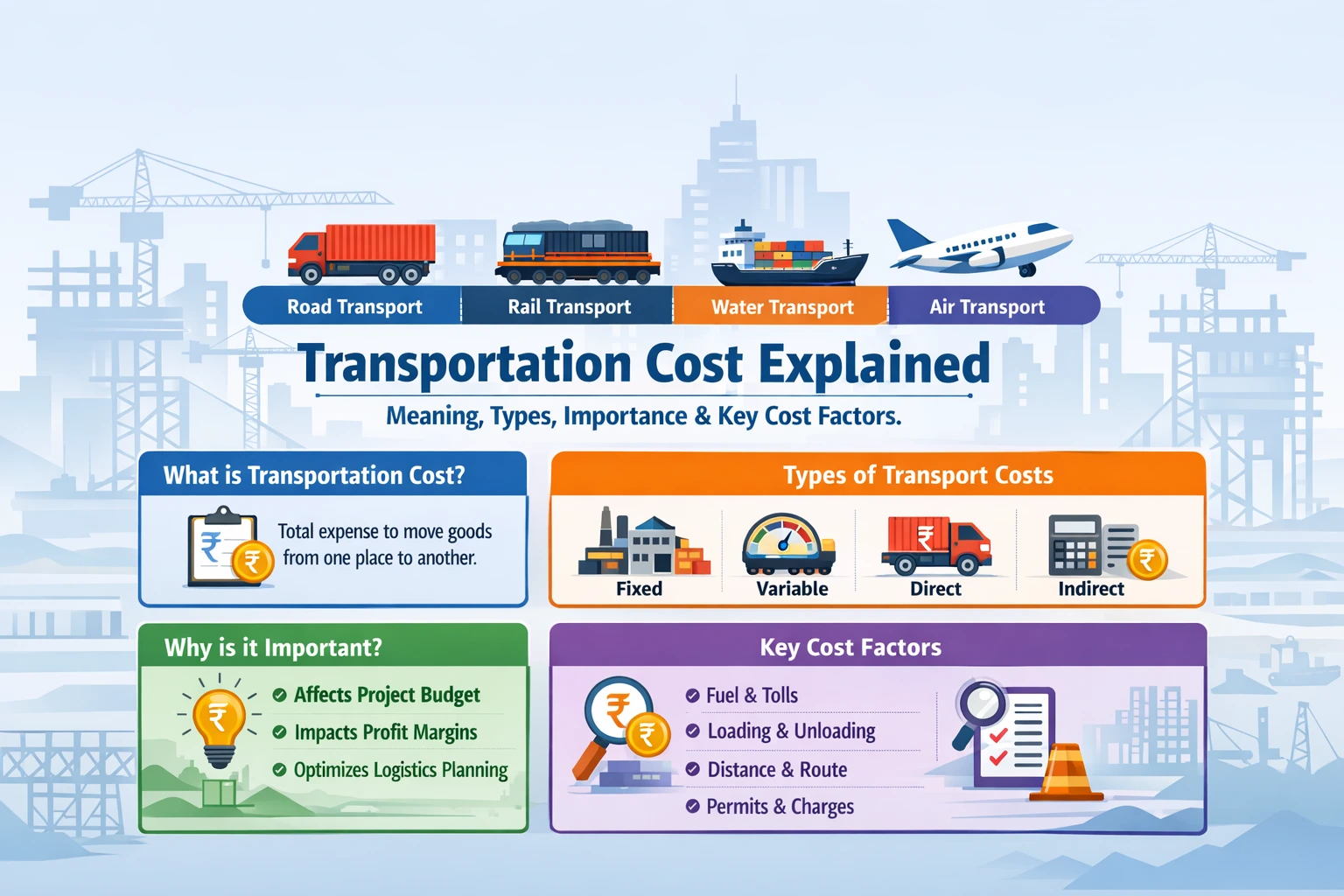
What is Transportation Cost? (Meaning)
Transportation cost refers to the total expense incurred to move materials, equipment, goods or finished products from one location to another.
This includes direct and indirect costs associated with fuel, labor, vehicles, handling, tolls, insurance and administrative expenses.
In industries like construction, fabrication, oil & gas, manufacturing and infrastructure, transportation cost is often a significant portion of the overall project cost and must be estimated accurately to avoid budget overruns.
Types of Transportation Cost
Transportation costs can be classified based on mode, nature and accounting treatment.
1. Based on Mode of Transportation
a) Road Transportation Cost
Road transport cost is the total expense involved in moving goods or materials by road using Trucks, trailers or container vehicles.
Road Transportation is flexible but affected by fuel prices and tolls.
In short:
It includes fuel cost, driver & helper wages, vehicle hire or depreciation, maintenance, tolls, permits, and loading–unloading charges required to transport materials from one place to another by road.
Commonly used for construction materials, fabrication items and short-to-medium distance logistics in India.
b) Rail Transportation Cost
Rail transportation cost is the expense incurred to move goods or materials by railway from one location to another.
In short:
It includes freight charges, loading–unloading, wagon hire, terminal handling, and documentation costs.
It is suitable and commonly used for bulk and long-distance transportation such as steel, cement, coal and aggregates.
Rail transportation cost has Lower cost per ton-km for long distances but limited by rail connectivity.
c) Water Transportation Cost
Water transportation cost is the expense involved in moving goods or materials by waterways such as sea, rivers or canals using Ships, barges, ports
In short:
It includes freight charges, port handling, loading–unloading, storage and documentation costs, and is mainly used for bulk, heavy and long-distance transportation due to its low cost per ton.
Road Transportation is most economical for international and bulk cargo
d) Air Transportation Cost
Air transportation cost is the expense incurred to transport goods by aircraft from one location to another.
In short:
It includes air freight charges, handling, security and documentation costs, and is used for urgent, high-value or lightweight goods because it is the fastest but most expensive mode of transportation.
2. Based on Cost Behavior
a) Fixed Transportation Cost
Fixed transportation cost is the cost that remains constant regardless of distance traveled or quantity transported.
It includes vehicle purchase or lease, insurance, permits, taxes and fixed staff salaries and does not change with the level of transportation activity.
b) Variable Transportation Cost
Variable transportation cost is the cost that changes with distance traveled, load or number of trips.
It includes fuel consumption, toll charges, maintenance and repair, loading–unloading and trip-based labor costs and increases or decreases based on transportation activity.
3. Based on Project Accounting
a) Direct Transportation Cost
Direct transportation cost is the cost that is directly attributable to a specific shipment, project or material delivery to site.
It includes freight charges, fuel, driver wages, tolls and loading–unloading costs incurred to transport materials or equipment directly to the required location or site.
b) Indirect Transportation Cost
Indirect transportation cost is the cost that supports transportation activities but cannot be directly linked to a single shipment or project.
It includes administrative expenses, supervision, storage, coordination, insurance overheads and logistics management costs associated with transportation operations.
Importance of Transportation Cost in Projects
Transportation cost directly impacts project feasibility, competitiveness and profit margins.
1. Accurate Cost Estimation
Correct transportation cost estimation ensures realistic project budgets and competitive bidding.
2. Project Scheduling & Planning
Timely transportation affects material availability, equipment mobilization and construction schedules.
3. Profitability Control
Underestimating transportation cost can quickly reduce or eliminate project profit.
4. Supply Chain Efficiency
Optimized transportation improves logistics efficiency and reduces delays and wastage.
5. Pricing & Quotation Accuracy
Transportation cost influences final material rates, BOQs
and client quotations.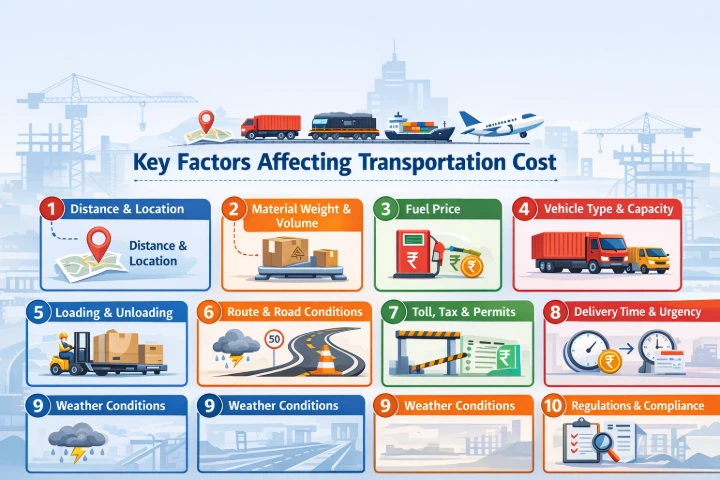
Key Factors Affecting Transportation Cost
Understanding these factors helps in better cost control and estimation accuracy.
1. Distance and Location
- Longer distance = higher fuel, labor and time cost
- Remote or difficult terrain increases expenses
2. Type and Weight of Material
- Heavy and bulky materials (steel plates, pipes, machinery) cost more
- Fragile or hazardous goods require special handling
3. Mode of Transportation
- Road vs rail vs sea vs air
- Each mode has different cost structures and limitations
4. Fuel Prices
- Fuel is a major variable cost
- Fluctuations significantly impact transportation budgets
5. Vehicle Type and Capacity
- Truck size, axle configuration, load capacity
- Underutilized vehicles increase cost per unit
6. Loading and Unloading Requirements
- Cranes, forklifts, labor and time
- Special equipment increases handling cost
7. Toll Charges and Taxes
- Highway tolls, entry taxes, permits and border charges
8. Lead Time and Urgency
- Express or urgent deliveries cost more
- Poor planning increases emergency transport expenses
9. Route Conditions
- Traffic congestion, road quality, weather conditions
- Affects fuel consumption and delivery time
10. Regulatory and Compliance Costs
- Transport permits
- Safety and environmental regulations
How to Reduce Transportation Cost Effectively
- Optimize route planning
- Use appropriate vehicle capacity
- Combine shipments (full truckload planning)
- Choose the most economical transport mode
- Schedule deliveries efficiently
- Negotiate long-term transport contracts
Transportation Cost in Construction & Fabrication Projects
In construction and fabrication projects, transportation cost is often included under:
- Material delivered cost
- Logistics cost
- Equipment mobilization and demobilization
Accurate transportation costing ensures:
- Better BOQ preparation
- Realistic tender pricing
- Improved project cost control
Conclusion
Transportation cost is a critical cost component that directly influences project success. By understanding its meaning, types, importance and key cost factors, engineers and estimators can prepare more accurate budgets, reduce risks and improve profitability.
Whether you are working on construction projects, fabrication works, manufacturing, or logistics planning, a clear understanding of transportation cost is essential for effective cost estimation and decision-making.