Labor Based Costing is a fundamental costing method used in manufacturing, fabrication, construction and service industries where labor cost is a major contributor to total project cost.

This method focuses on accurately calculating labor hours, wage rates, productivity and associated overheads to determine the true cost of work.
In this blog, we will explain what labor-based costing is, its importance, a step-by-step process and a practical calculation example to help estimators, engineers and project managers prepare accurate cost estimates.
What is Labor Based Costing?
Labor Based Costing is a costing technique where the primary cost driver is labor hours or labor rate.
The total cost is calculated by multiplying required labor hours by applicable wage rates, including allowances, benefits and indirect labor costs.
This method is widely used when:
- Work is manpower-intensive
- Machine usage is limited
- Productivity varies based on skill level
Importance of Labor Based Costing
Labor based costing helps organizations to:
- Prepare accurate project estimates
- Control labor productivity and efficiency
- Avoid cost overruns
- Improve pricing and bidding accuracy
- Monitor actual vs estimated labor performance
Step-by-Step Process of Labor Based Costing
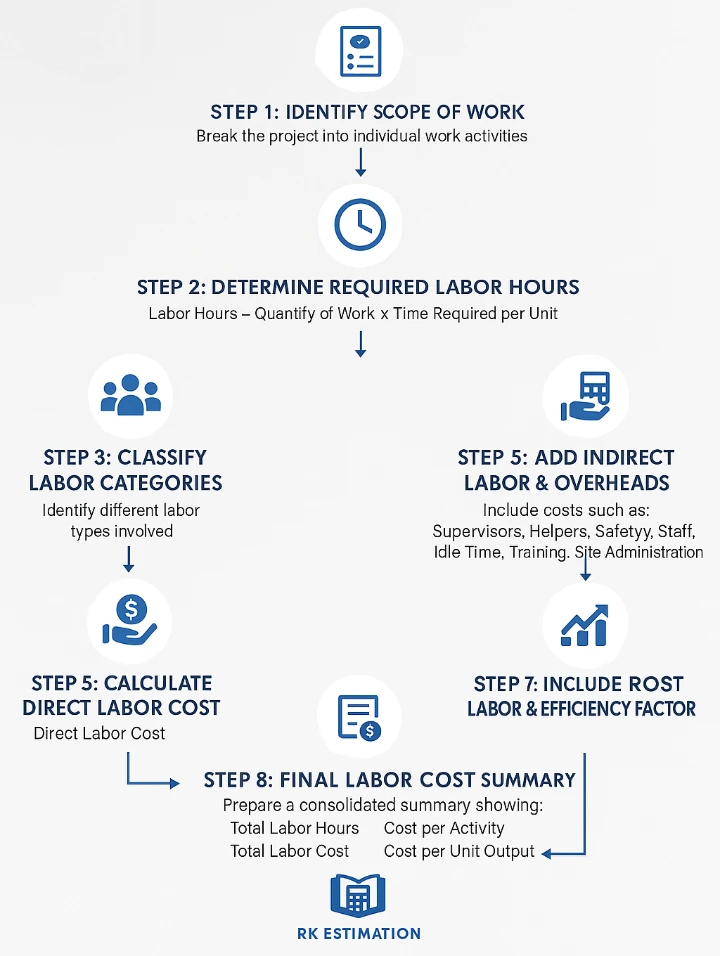
Step 1: Identify Scope of Work
To identify scope of work, break the project into individual work activities, such as:
- Cutting
- Welding
- Assembly
- Installation
- Finishing
Each activity should be measurable and clearly defined.
Step 2: Determine Required Labor Hours
Estimate the standard labor hours required for each activity based on:
- Historical data
- Productivity norms
- Industry benchmarks
- Past project experience
Formula: Labor Hours = Quantity of Work × Time Required per Unit
Table 1: Activity-Wise standard labor hours Calculation
| Activity | Quantity | Time per Unit (Hr) | Total Labor Hours |
| Cutting | 100 | 0.2 | 20 |
| Welding | 100 | 0.3 | 30 |
| Assembly | 100 | 0.15 | 15 |
| Total Hours | 65 |
Purpose: Calculates standard labor hours without productivity losses or gains.
Step 3: Classify Labor Categories
Identify different labor types involved:
- Skilled labor
- Semi-skilled labor
- Unskilled labor
- Supervisory staff
Each category may have a different wage rate.
Step 4: Determine Labor Rates
Calculate hourly labor rates including:
- Basic wage
- Overtime allowance
- PF / ESI / statutory benefits
- Incentives
- Welfare expenses
Formula:
Hourly Labor Rate = Total Monthly Cost ÷ Working Hours per Month
Hourly Labor Rate = Monthly Salary / (Working Days * Hours per Day)
Table 2: Labor Category & Hourly Rate Calculation
| Labor Type | Monthly Salary | Working Days | Hours/Day | Hourly Rate |
| Skilled | 52000 | 26 | 8 | 250 |
| Semi-Skilled | 41700 | 26 | 8 | 200 |
| Unskilled | 17600 | 26 | 8 | 85 |
Purpose: Converts monthly wages into hourly labor rates.
Step 5: Calculate Direct Labor Cost
Multiply labor hours by labor rate for each category.
Formula: Direct Labor Cost = Labor Hours × Hourly Rate
Table 3: Direct Labor Cost Calculation
| Labor Type | Labor Hours | Hourly Rate | Direct Labor Cost |
| Skilled | 30 | 250 | 7500 |
| Semi-Skilled | 15 | 200 | 3000 |
| Unskilled | 5 | 85 | 425 |
| Total Direct Labor Cost | 10500 |
Step 6: Add Indirect Labor & Overheads
Include costs such as:
- Supervisors
- Helpers
- Safety staff
- Idle time
- Training
- Site administration
These can be added as:
- Percentage of direct labor cost, or
- Fixed cost per hour/day
Table 4: Indirect Labor & Overhead Cost
(Total 15% of Direct Labor cost in Below case)
| Description | Percentage | Cost (₹) |
| Supervision | 8% | 840 |
| Safety & Welfare | 4% | 420 |
| Idle Time | 3% | 315 |
| Total Indirect Cost | 15% | 1575 |
Step 7: Include Productivity & Efficiency Factor
Adjust labor hours for:
- Learning curve
- Site conditions
- Skill variation
- Weather or shift work
Formula: Adjusted Labor Hours = Estimated Hours × Productivity Factor
Formula: Adjusted Labor Hours=Quantity * Time per Unit * Productivity Factor
Table 5: Activity-Wise Adjusted Labor Hours Calculation
| Activity | Quantity | Time per Unit (Hr) | Productivity Factor | Total Labor Hours |
| Cutting | 100 | 0.2 | 1.05 | 21 |
| Welding | 100 | 0.3 | 1.1 | 33 |
| Assembly | 100 | 0.15 | 1 | 15 |
| Total Hours | 69 |
Purpose: Calculates adjusted labor hours considering productivity losses or gains.
Step 8: Final Labor Cost Summary
Prepare a consolidated summary showing:
- Total labor hours
- Cost per activity
- Total labor cost
- Cost per unit output
Formula: Final Labor Cost per Unit=Total Labor Cost / Total Quantity
| Total Direct Labor Cost (₹) | 10500 |
| Total Indirect Labor Cost (₹) | 1575 |
| Total Labor Cost (₹) | 12075 |
| Total Quantity Produced | 100 |
| Labor Cost per Unit (₹) | 120.75 |
Labor Based Costing – Practical Calculation Example
Example: Fabrication of 100 steel brackets
Given:
- Labor time per bracket = 0.5 hours
- Total quantity = 100 brackets
- Skilled labor rate = ₹300/hour
- Indirect labor overhead = 15%
Step-by-Step Calculation:
1. Total Labor Hours=100 × 0.5 = 50 hours
2. Direct Labor Cost=50 × ₹300 = ₹15,000
3. Indirect Labor Cost=15% of 15,000 = ₹2,250
4. Total Labor Cost = ₹15,000 + ₹2,250 = ₹17,250
5. Labor Cost per Unit= ₹17,250 ÷ 100 = ₹172.50 per bracket
Advantages of Labor Based Costing
- Simple and transparent method
- Suitable for manpower-intensive projects
- Easy to monitor and control
- Improves labor productivity tracking
Limitations of Labor Based Costing
- Less accurate for machine-driven operations
- Highly dependent on productivity assumptions
- Requires accurate labor time estimation
Where Labor Based Costing Is Commonly Used
- Fabrication & welding shops
- Construction projects
- Maintenance work
- Repair & job work costing
- Small and medium manufacturing units
Conclusion
Labor Based Costing is a powerful and practical costing method when labor plays a dominant role in production or project execution.
By following a step-by-step approach and using realistic labor rates and productivity factors, businesses can achieve accurate cost estimation and better cost control.
At RK Estimation, we help professionals understand and apply practical costing methods for real-world projects.